

Sometimes, the manner of dying can rend the heart. No one reading Jonathan Dimbleby’s account of his brother’s death from motor neurone disease, or Anthony Horowitz’s description of his mother’s death from pancreatic cancer, can fail to sympathise with their anguish. Or with their frustration that a less distressing manner wasn’t available. Still, it’s not enough to feel; we also have to stand back and think. And once we start thinking, the conclusions that Jonathan and Anthony draw from their experiences become less persuasive.
Both see the obvious solution as the legalisation of assisted suicide. (I avoid talking of “assisted dying”, because it hides the truth that what’s envisaged is helping someone kill themselves.) So, Jonathan is angry at what he considers the unwarranted delay in the passage of Kim Leadbeater’s Terminally Ill Adults (End of Life) Bill, which would legalise assisted suicide for the dying, through the House of Lords. After all, the bill has already received “exhaustive scrutiny” in the Commons and is, he implies, fit to become law.
But that’s not true. On 9 May, shortly after the Commons had finished its clause-by-clause deliberations, the Royal College of Physicians made this statement: “Whilst the bill has undergone a number of changes during the… committee phase, there currently remain deficiencies that would need addressing to achieve adequate protection of patients and professionals”. Four days later, the Royal College of Psychiatrists, which had been refused the opportunity to present evidence, voiced “serious concerns” and declared that “with too many unanswered questions about the safeguarding of people with mental illness, the College has concluded that it cannot support the Bill in its current form”.
This external vote of no confidence was reflected inside the Commons, where, during the bill’s passage, confidence in its safeguards against abuse plummeted. Before the final vote, its majority halved and had only 12 MPs changed their votes from Yes to No, the Lords wouldn’t be discussing it at all. Hansard records that some MPs only voted it through on the assumption that the Upper House could somehow sort out what they had failed to. Since then, the reports of three Lords select committees have confirmed doubts by exposing serious deficiencies in the legislation. The committee on the constitution found the Commons’ poor scrutiny of a bill of such consequence “especially concerning”.
Jonathan also tells us that “the British public… have consistently shown overwhelming support” for the bill. That’s true, but it obscures important qualifications. Many members of the public don’t understand what they’re supporting. In November 2024 a Focal Data poll of over 5,000 people found that 40% do not properly understand what “assisted dying” means, unable to define it as providing those within six months of death lethal drugs. One in six wrongly thought it included hospice care, and over half thought it included the right to refuse life-prolonging treatment. It also found that 66% wanted the provision of social and end-of-life care “sorted out first” before any thought is given to permitting assisted suicide. The same month a More in Common poll of over 2,000 people confirmed that, while a solid majority support “assisted dying”, their support is conditional on the provision of robust safeguards. It also revealed that 74% don’t believe that the NHS is currently fit to provide them.
While it’s understandable that Jonathan’s vision is dominated by the distressing experience of his brother’s dying, Members of Parliament cannot legislate simply on the basis of individual cases, however harrowing. They must consider the wider and long-term social ramifications of a law and weigh up its risks. That’s why parliamentary support for legalising assisted suicide has always been lower than the general public’s. That’s also why Anthony is wrong. “It’s my death I’m talking about,” he writes, pleading that he should be free to exercise his autonomy. But the law cannot be made just for him or for individuals like him; it has to be made for everybody.
Consequently, when the Leadbeater bill reached the House of Lords last September, noble parliamentarians faced a dilemma. On the one hand, they heard the persistent concern of advocates for the disabled and several Royal Colleges about the risks of coerced ‘autonomy’ and corrosion of humane social norms that legalisation entails. On the other hand, their compassion was aroused by stories of individuals suffering grievously, whose plight couldn’t be assuaged by palliative care. The bill, urged its champion Lord Falconer of Thoroton, would resolve this intolerably cruel situation.
Except that it wouldn’t. By limiting assisted suicide to the terminally ill, the bill excludes those who aren’t dying but are still suffering grievously. So, anyone who supports the bill, genuinely intending that terminal illness should remain a condition of eligibility, accepts that some people, tragically, have to suffer grievously – because the social dangers of wider access are just too great. But if this tragically imperfect situation is supposed to be tolerable, why is the tragically imperfect status quo not so?
Of course, many supporters view terminal illness, not as a permanent limitation, but as a tactical beachhead for later strategic expansion.
Which it would be.
Because although the bill’s text doesn’t mention the relief of “unbearable suffering” or respect for “autonomy”, no one reading Hansard can doubt that those are the principles driving some of the legislative intent. So, after the law has approved assisted suicide for the terminally ill, the argument would soon be heard – with appeal to Articles 8 and 14 of the European Convention of Human Rights – “Why the unfair discrimination? If autonomy for the terminally ill, why not also for the chronically ill? And if the physically ill, why not also the mentally distressed? Don’t they suffer unbearably, too?”
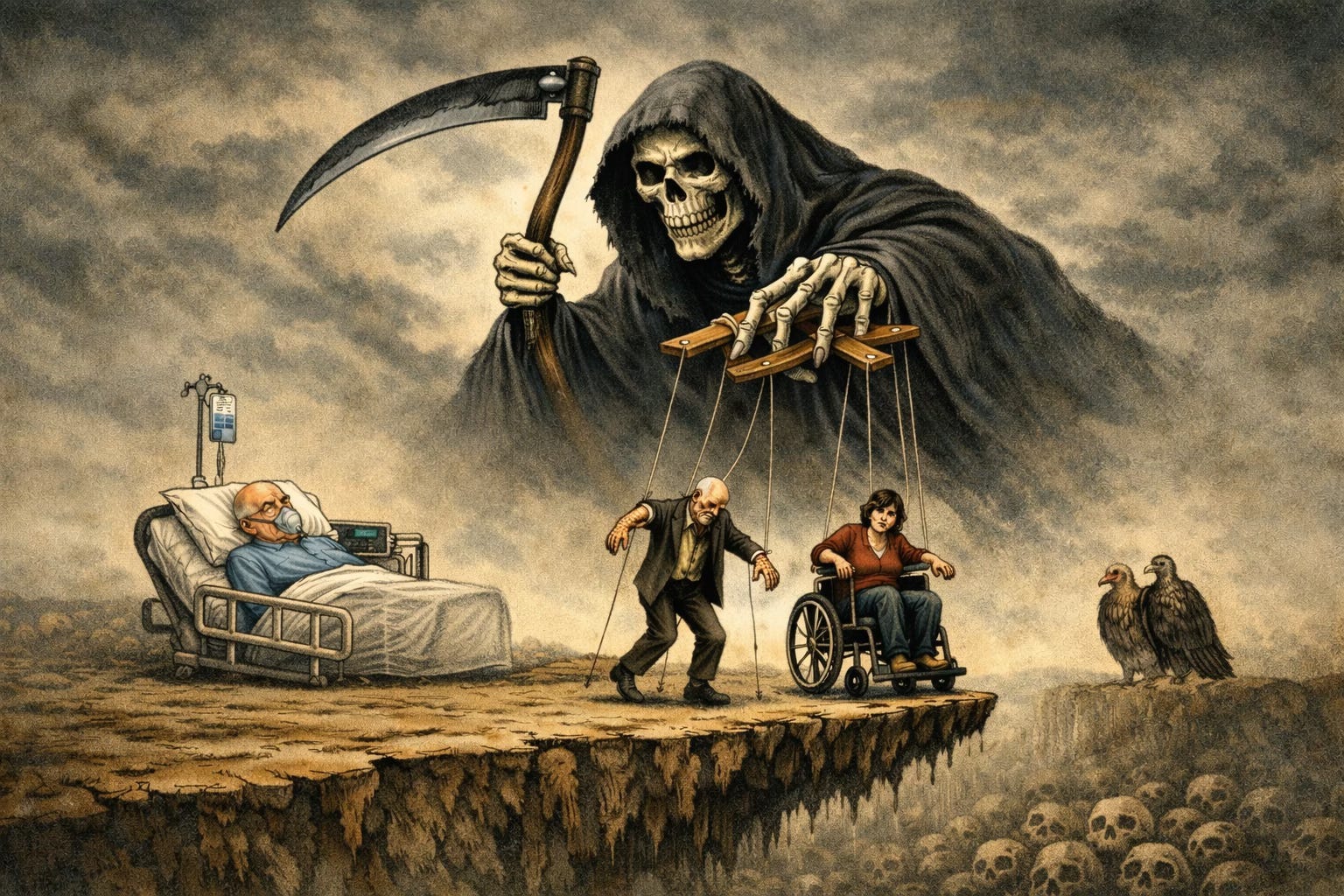
Several speakers in the Lords’ Second Reading asserted the individual’s “fundamental right to autonomy” as an axiom, turning a completely deaf ear to warnings of legalisation’s social dangers. Were axiomatic autonomy to dominate the field, the end of its logic would be the right to assisted suicide for all sane, mature adults. Which, if they’re deemed mature enough to elect governments – as Keir Starmer’s No 10 intends – might one day include 16-year-olds. If we were serious about reducing the quantity of human suffering, we wouldn’t be focussing on legalising assisted suicide, probably accessed by a maximum of 7,500 people within a decade. Rather, we’d focus on the universal provision of good palliative care, which more than 100,000 citizens every year need, but don’t get.
Indeed, if Parliament were to pass the bill before securing that, it would create a grave inequality of autonomies. For, while some – typically more privileged – would have a choice between decent palliative care and assisted suicide, others – typically poorer and less white – would have to choose between grievous suffering and killing themselves. As Gordon Brown has argued, there is no real choice “if the alternative option, the freedom to draw on high-quality end-of-life care, is not available”. That’s why in its 2012 report the Demos Commission, chaired by Lord Falconer himself, stipulated as an “essential” precondition of legalisation, the universal provision of “the best end of life care available”.
So, when Jonathan claims that the proliferation of amendments and the slow passage of the bill through the House of Lords is due to the bad faith politicking of “a very small but prominent group of peers”, he’s wrong. During the Lord’s Second Reading, an extraordinary 160 members – from all sides of the House and of all faiths and none – signed up to speak, two-thirds of them voicing doubts. Amendments have since been laid by over 50 peers, not just the six that Jonathan fingered.
The Leadbeater bill is one of the most socially consequential legislative proposals to come before any parliament. As a private members bill not in the Government’s Election manifesto, peers aren’t bound to pass it. And they are duty-bound not to pass it, if they deem it unsafe. As Professor Mark Elliott, former Legal Adviser to the Lords Constitutional Committee, has written: “Any argument that it would be undemocratic or otherwise constitutionally suspect for the Lords to do anything other than rubber-stamping the Bill would be wide of the mark.”
In the days of Gordon Brown, socialists were more honest, however ignorant of the realites of life in the socialist paradise they envied so much in the Soviet Union. And they were motivated largely by compassion, if only for a certain class of people. The modern technocratic socialist of Starmer's Gang, riddled as it is with Fabians, is all deceits and lies and cares nothing for human lives. We are all, as barrister Steven Barrett says, meat units in the service of a state ruled by Starmer's Gang.
No doubt it will get worse. I would not be surprised if Starmer's Gang were to classify 'hard right thugs' as mentally ill, incarcerates them in mental hospitals and directs the NHS to forcefully encourage the poor souls to choose euthanasia.
Many thanks for another excellent article. I hadn't given this topic much attention till now, but this piece has clarified things greatly, and has exposed the rot at the heart of the bill: it's another bad, emotive piece of legislation. But it seems worse than just that, because it's the luvvie classes that, in their contempt and conceit and virtue-signalling, are driving this, to the detriment of those less fortunate. It seems to sum up our times.