

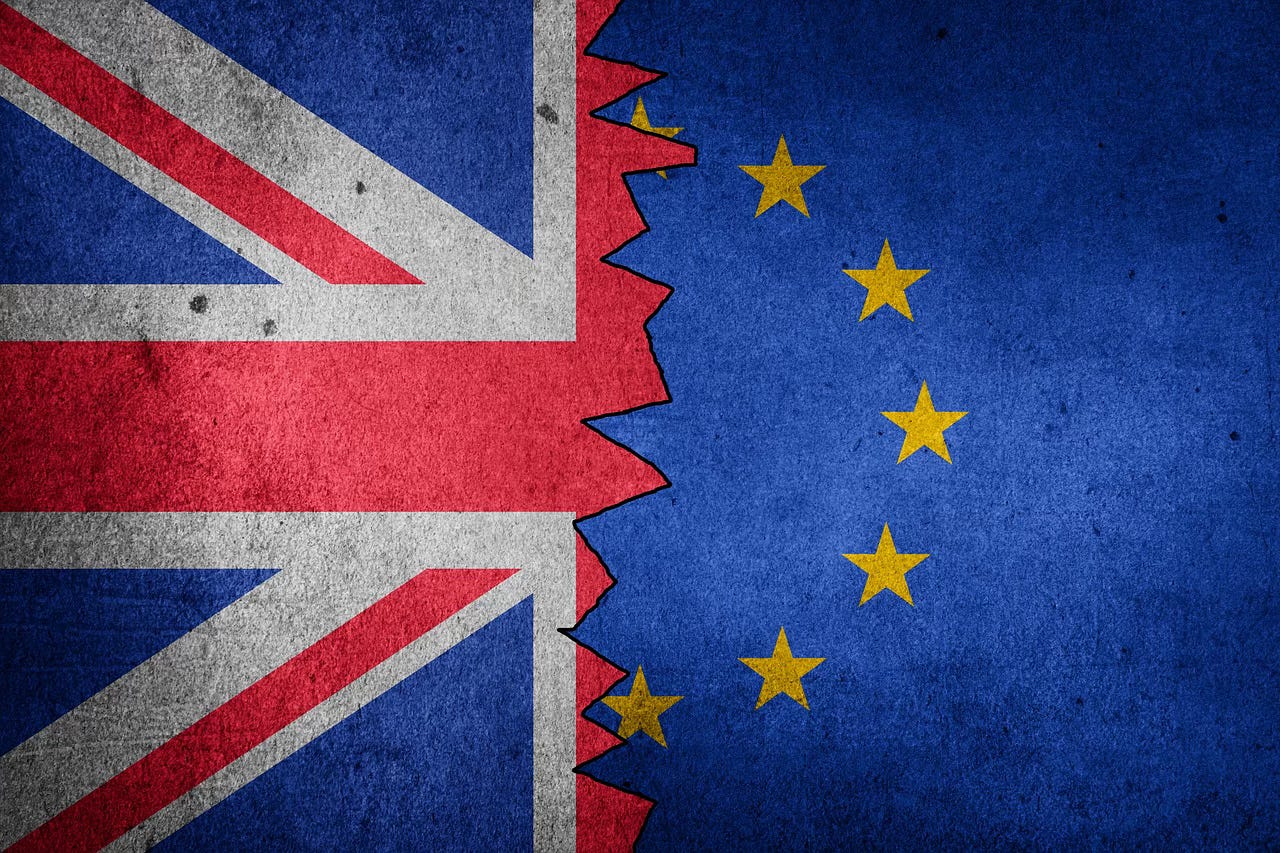
What follows largely comprises the first half of a chapter that appears in The Brexit Effect, 2016-2026 (Cambridge: Cambridge University Press, 2026), edited by Anthony Seldon. In it I explain why I voted (by a narrow margin) in the 2016 referendum for Britain to remain in the European Union. Next week, I’ll explain why I’ve changed my mind and would vote to stay out now.
I
I am an icon of Brexit, it seems. In 2019 Richard Drayton, Rhodes Professor of Imperial History at King’s College London, contributed “Biggar vs Little Britain: God, War, Union, Brexit and Empire in Twenty-First Century Conservative Ideology,” to a collection of essays entitled, Embers of Empire in Brexit Britain.[1] In this he wrote: “[A] journey into the mind-world of Biggar can help us to understand the larger, and less articulate and visible cultural currents in late twentieth and twenty-first century Britain. It may provide insight into how some of the embers of empire continue to burn, and even to kindle obscure new flames…. The Biggar phenomenon is a sign of the times to which we should pay attention”.[2]
Awfully flattered as I am by the cultural importance Professor Drayton attaches to me, I regret to say that he is mistaken. First of all, I am not aware of any hard and comprehensive empirical data that substantiates the claim that voters were generally moved to vote Leave in the June 2016 referendum by “imperial nostalgia”, in the vain hope that Brexit would liberate Britain to recover the kind of global dominance she enjoyed in 1900.
Next, while Drayton claims that my 2016 blog, “The Nation-State and the Case for Remaining in the EU,” comprised an argument for leaving the European Union,[3] my concluding two sentences ought to have shown him otherwise: “There may well be good reasons for Britain to remain in the EU But if that is so, the unchristian nature, or the obsolescence, of the nation-state is not one of them”. [4]
Yes, it is true that I believe that Britain should continue its imperial tradition of playing a global role, sometimes deploying hard power in faraway places to uphold international order and halt massive atrocities. I also believe in the value of the United Kingdom as a remarkably successful multinational state. But those are views shared by plenty of Remainers and repudiated by lots of ‘Little England’ Leavers.
Finally, by far the largest fly in Professor Drayton’s narrative ointment is that I actually voted to remain in the EU in 2016. Indeed, I went so far as to wager a lunch and a dinner on a 52/48 per cent victory for Remain. (I got the figures right, but not the bias.)
Let me explain.