

I’ve long been fascinated by civil conflict and what’s required to navigate it successfully. It doesn’t take much reflection to bring to mind that my interest springs from personal experience. As a youngster, I was burdened with the role of mediating between my unhappy, warring parents. And since then, I’ve found myself playing the same role, again and again. It’s emotionally exhausting, trying to discern where fault and justice lie, straining to be fair, persuaded by the last party I listened to, sure that I’ve finally got it right, then realizing I got it wrong, and having to go back and look again. Sometimes, I’ve finally had to take the side of one party and incur the resentful disappointment of the other. It’s really not a lot of fun. But there are some conflicts one just can’t walk away from. You just have to go through them, not around.
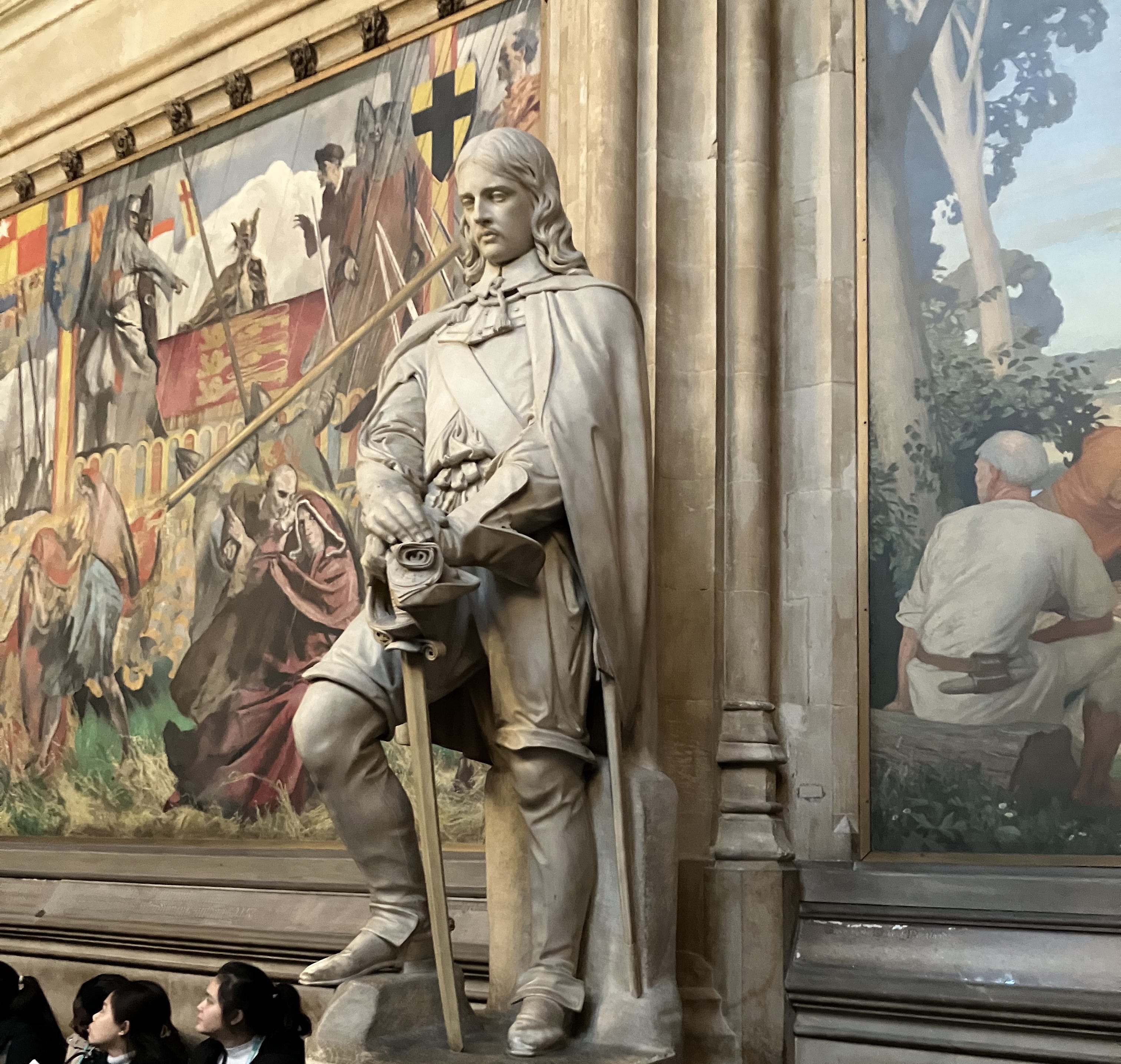
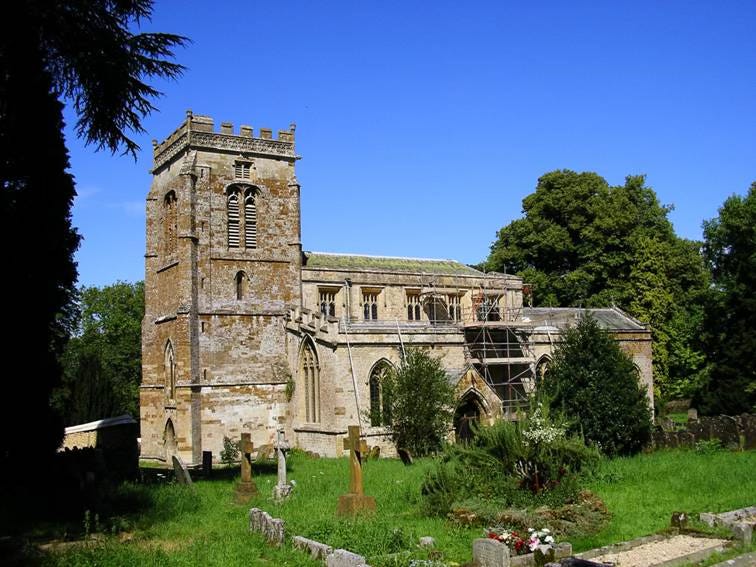
So, it’s not surprising that I became fascinated by the story of Lucius Carey, Second Viscount Falkland, which I first encountered two decades ago when reading the plaque on the south wall of St Michael’s Church, Great Tew, about twenty miles north of Oxford. A short man with a high-pitched voice, Falkland was born in 1609 or 10 at Burford Priory and educated at St John’s College Cambridge and Trinity College Dublin. After a bruising quarrel with his father, who disapproved of his marriage, he stormed off to fight with the Dutch against the Spanish in the Netherlands, but he returned shortly afterwards to the estate at Great Tew, which he had inherited from his maternal grandfather.
During the 1630s Falkland built up a considerable library and kept open house for literary, philosophical, and theological folk who would regularly troop up from Oxford—among them the playwright, Ben Jonson, and the political philosopher, Thomas Hobbes. And of a summer’s evening, they would walk and talk in the walled garden that still stands. (The house itself was pulled down and completely rebuilt in the 19th century).
The core of those whom Falkland gathered around himself shared a common set of values and attitudes. The ‘Great Tew Circle’ (as they later came to be called) were much disturbed at what one of them, Edward Hyde, Earl of Clarendon, termed “the brawls which were grown from religion”. In response to these ‘brawls’, Falkland’s Circle identified itself with the Christian humanist tradition stemming from Erasmus and Richard Hooker. They championed the use of reason in matters of religion; they followed St Paul in distinguishing between fundamentals and adiaphora (or matters indifferent), advocating tolerance on the latter; and they looked for the reunion of Christendom.
Falkland’s own mother was converted to Rome, as were all his brothers and sisters. He himself refused; but another of the Great Tew fellowship, William Chillingworth, was briefly converted, sent to Douai in northern France, and put to writing an apologia for Roman Catholicism. Some short way into this project, he decided he’d made a mistake, returned to Great Tew, and wrote The Religion of the Protestants a Safe Way to Salvation.
Falkland’s pacific nature, and its Christian witness, is well captured by his close friend Clarendon, who wrote of him: “in all those controversies, he had so dispassioned a consideration, such a candour in his nature, and so profound a charity in his conscience, that in those points, in which he was in his own judgment most clear, he never thought the worse, or in any degree declined the familiarity, of those who were of another mind; which without doubt is an excellent temper for the propagation and advancement of Christianity”.
And here is Falkland himself writing in his discourse, Of the Infallibility of the Church of Rome:
… it is plaine, that [the emperor Constantine] thought punishing for opinions to be a mark, which might serve to know false opinions by…. I am sure Christian Religions chiefest glory being, that it encreaseth by being persecuted; and … me thinks … everything is destroyed by the contrary to what settled and composed it… I desire recrimination may not be used; for though it be true, that Calvin had done it, and the Church of England, a little (which is a little too much)…, yet she (confessing she may erre) is not so chargeable with any fault, as those which pretend they cannot, and so will be sure never to mend it; …
I confess this opinion of damning so many, and this custome of burning so many, this breeding up those, who knew nothing else in any point of religion, yet to be in a readinesse to cry, To the fire with him, to hell with him …These I say, in my opinion were chiefly the causes which made so many, so suddenly leave the Church of Rome.… If any man vouchsafe to think, either this [discourse], or the authour of it, of value enough to confute the one, and informe the other, I shall desire him to do it … with that temper, which is fit to be used by men that are not so passionate, as to have the definition of reasonable creatures in vaine, remembering that truth in likelyhood is, where her author God was, in the still voice, and not the loud wind ….
And here he is, again, in a remarkably gracious response to a Roman Catholic critic:
I am also to thank you … for not mixing gall with your inke; since I have ever thought that there should bee as little bitterness in a treatise of controversie, as in a love-letter, and that the contrary way was void both of Christian charity, and humane wisedome, as serving onely … to fright away the game, and make their adversarie unwilling to take instruction from him, from whom they have received injuries, and making themselves unabler to discover the truth (which Saint Au[gu]stine sayes is hard for him to find who is calme, but impossible for him that is angry) ….
Late in the 1630s Falkland, a naturally contemplative and reflective sort, got himself elected to Parliament, where he became one of the most prominent and eloquent critics of King Charles I’s arbitrary government and a consistent defender of the rule of law. In one parliamentary speech he said, “the cause of all the miseries we have suffered, and the cause of all our jealousies we have had, that we should yet suffer, is, that a most excellent prince hath been infinitely abused by his [counselors], telling him that by policy he might do what he pleased”.
Nevertheless, when civil war began to loom, Falkland was reluctantly persuaded to side with the king and eventually became his Secretary of State. King Charles may have lived to regret his choice, because he was heard on several occasions to complain bitterly about how rudely Falkland sometimes spoke to him.
In the early stages of the conflict, Falkland and other members of the Great Tew Circle were involved in several, secret, politically risky initiatives to reconcile king and parliament—but all in vain. Conscious that his peace-making reputation was being mistaken for cowardice, Falkland made a point of putting himself at the very front of battle. In 1642 at the end of the battle of Kineton (better known as Edgehill), about ten miles north of Great Tew, Falkland interposed himself between his own victorious royalist comrades and a group of sorry parliamentarians, to stop the former slaughtering the latter. Through such a courageous demonstration of self-sacrificial charity, he implicitly gave the lie to the cynical view that his one-time guest, Thomas Hobbes, would develop, namely, that at bottom all that motivates human beings is the individual’s fear of pain and death.
