

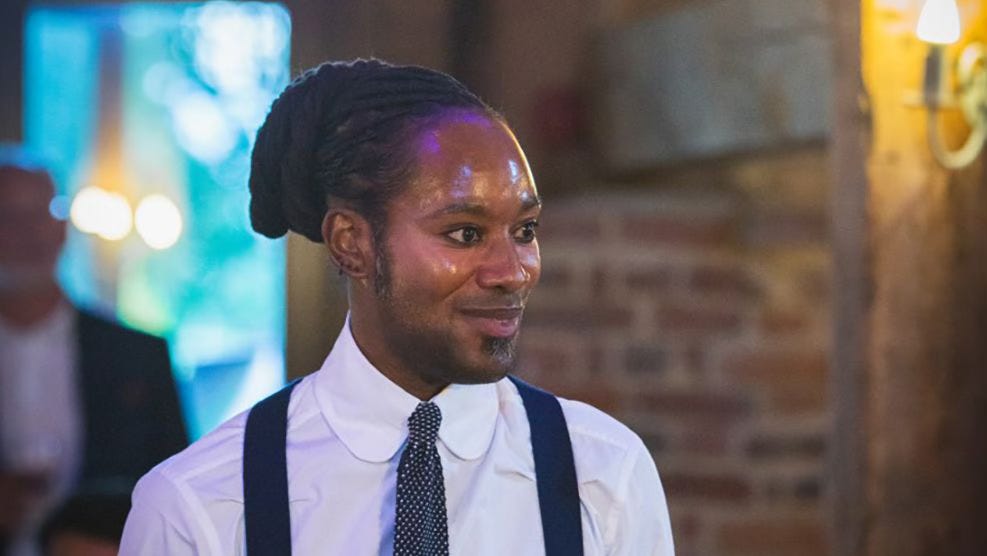
The centre of gravity in the Arday Affair has shifted. Public discussion no longer focuses on evidence that Cambridge University’s youngest black holder of a professorial chair plagiarised considerable portions of his PhD, embellished his c.v. with three academic appointments at institutions that now deny it, and claimed to be the author of a book that was never written. The focus has moved on to the question of why he was appointed in the first place, and what that tells us about the state of academe.
This is good. For Jason Arday himself I feel somewhat sorry. Yes, he’s been serially dishonest. And yet, from what I’ve observed, he really believes his own lies. In brushing aside critics as “racially motivated”, he sounds as if he sincerely means what he says. He’s trapped in a world of fantasy. Whatever his personal guilt, there’s a tragic quality to his predicament. For, when reality does finally break through, Nemesis will enter, too. A terrible reckoning will cause the self he’s constructed to disintegrate. I fear for his life.
And that makes me angry—but not with his critics. It makes me angry at all the adults who failed to call him out. Who indulged him. Who lowered the threshold so he could clamber over it. Who encouraged him to dismiss criticism as expressions of ‘eurocentric’, colonialist, racist bad faith. Who aided and abetted the elaboration of his fantasy, year after year.
Latest among them are the eight professors and the vice-chancellor’s deputy on the committee that unanimously recommended his Cambridge appointment. Evidently, they failed to scrutinise him. But why? One leading candidate for the answer is the identity of the applicant: an autistic man of African heritage, possessing double membership of historically marginalised and victimised groups.
I find this explanation entirely plausible. I’ve witnessed at first-hand how some professors, even at our most prestigious universities, use their victim-identity as a get-out-of-gaol card. How they deploy it to trump intellectual standards and by-pass accountability before the bar of reason. And how their anti-rational behaviour prevented neither their appointment nor their promotion.
Several years ago, I was invited to take part in a panel discussion about empire in Oxford. One of my fellow panellists was a female professor of international relations. At one point in our discussion, I turned to her and said, “A few moments ago, you said X. Now you’ve just said Y. They’re not consistent”. Waving her hand imperiously, she swept my complaint off the table, exclaiming, “Enough of your donnish, tutorial tactics!”
I was struck dumb, feeling—and I use the word advisedly—unmanned. But, later, I reflected, “Are there no rules to this game any longer? And if not, what on earth is the point?” Clearly, our discussion had not been a searching out of the truth together by common submission to the disciplines of logic and evidence. It was merely the occasion for the declamation of a preferred narrative and silencing criticism by the insinuation of bad faith. Hence, ‘tactics’.
But there was more. For, my tactics had also been described as ‘donnish’, which connotes fusty white males in tweed jackets, reeking of pipe smoke circa 1950. My fellow panellist was also exploiting her political power as a member of a group commonly stereotyped as victims (women) over a member of a group commonly stereotyped as victimisers (men). I was aware that, in response to the dismissal of my criticism, my tongue was tied, partly because the one doing the dismissing was a woman and I was a man. And her choice of words took care to remind me of that. Rather than a forum for finding out the truth, our discussion had been an arena for the exercise of power.
This was no isolated incident. In my recent book, The New Dark Age: Why Liberals must Win the Culture Wars, I report one of many similar cases on the far side of the Atlantic. After serving as a professor of political science at Alberta’s Mount Royal University for fourteen years, Frances Widdowson was fired in 2021. Why? Because she challenged the university’s policy of requiring its members to ‘respect’ and ‘value’ indigenous ways of knowing. When she disagreed that traditional native American ‘star knowledge’ should be viewed in the same way as astronomical science, indigenous studies professors accused her of racist harassment, making the campus ‘unsafe’ for them. Widdowson sees her particular experience as an instance of a wider phenomenon in universities, where differential treatment on the basis of one’s identity “is becoming the norm”.
The silver lining of the Arday Affair’s dark cloud is that it has lifted the lid on this problem in academe, just as the murder of Henry Nowak exposed it among the police. Now it’s up to us to get the measure of it. A local investigation by the University of Cambridge isn’t enough. We need a national inquiry into the corrupting effect of identity politics on our universities.
I just sent this letter to the Vice Chancellor of the University of Cambridge. Although I generally think that those at the top should take responsibility for the workings of their organisations, I think there is urgent work to do, inconsistent with taking the time to find a successor. I don't really expect a response...
Dear Professor Prentice
The positive flywheel that has spun in Cambridge’s favour for centuries might reverse direction. You must urgently and publicly act to avoid this.
I am an alumnus of the University. I matriculated in 1978 and am a member of Downing College.
When I first went up it was the proudest day of my life and the result of much hard work – not just mine, but that of my teachers at Hyde County Grammar School in Tameside. I was a cliché - the first in my family to go to university. I continued to work hard and went on to be awarded a First in Economics and this, especially from the institution that granted it, has been a solid foundation to my entire life. In a very real way, Cambridge was the making of me.
The university of which you are Vice Chancellor had a reputation the equal of any of the great universities globally. Such a thing – such a reputation – took centuries to build and many thousands of people like me have relied upon it to underwrite their own abilities and achievements. All lose when that reputation is damaged.
You have certainly guessed by now why I am writing to you. Unless you take firm and very public measures, the Jason Arday fiasco risks untold damage to the reputation of the organisation you lead. It has already started to metastesise, with attention turning to Asst. Prof. Farah Ahmed.
Others - current students, PhDs and members of faculty - are even more exposed than alumni; they rely on the good management and good institutional sense of the university to validate their daily efforts and the quality of their academic work. High calibre people from academia considering a move to Cambridge – until now an honour – will be concerned for their careers and reputation. From being an accepted positive, the Cambridge name risks becoming a negative. The best scholars at every level might consider Cambridge a risky choice and go elsewhere - as might their funding and donations more generally.
The positive flywheel that has spun for centuries might reverse direction.
After graduation I had a career in business, including as CEO. Had any organisation I led been faced with the essential risks that currently face the University of Cambridge, we would have worked with a core team at speed to identify the core causal factors and developed a plan to react rapidly, decisively and publicly.
The University needs to eradicate anything that subtracts from merit as the basis for advancement of any kind – from entrance of undergraduates at one extreme to the election of tenured professors at the other. To anyone outside academia, like me, Cambridge has severely devalued its key institutional claim – to attract, employ and teach at the very highest academic standards.
I understand that in the case of Dr Arday it was DEI that caused you to lose your footing so comprehensively. If this is the case, I presume a plethora of other areas across the university are equally impacted by this departure from the merit-based straight and narrow. You must urgently act to reverse these effects – they are quite simply at odds with academic excellence.
You are effectively the CEO of the University of Cambridge. I’m quite sure that this job is more complex and nuanced than the following gives credit for. For this, forgive me. I also know none of the participants, so can suggest action that might otherwise be unpalatable. It might, however, be required.
· Insofar as the specifics of Dr. Arday’s appointment are concerned, once the investigation you have commenced makes its findings I would, if merited, consider sacking Professor Cremin and stripping the members of the appointment board of their positions. These actions should be publicly signalled.
· I would consider announcing a university-wide programme of credential verification. To avoid any accusations of bias, no-one should be exempt. I would make dismissals wherever they were justified.
· I would make a public statement that academic excellence was Cambridge’s only metric, that DEI would no longer have any place in Cambridge’s processes, and that any members of faculty who are discontented with this decision should consider their futures in the university.
This may sound an extreme programme, but I believe you and our university to be at a critical moment that, unless firm action is taken (and, critically, is seen to be taken), might be the inflection point when Cambridge ceases to be a world-class university and becomes an attractive tourist attraction with a debased seat of learning, a thing of the past, occupying its ancient walls.
Professor Prentice – don’t be the captain on whose watch the flywheel starts to spin in the wrong direction.
Yours faithfully
Keith Carter
But who would sit on such an enquiry and by whom would they be chosen and under what terms of reference would they operate? Despite the inevitable terrible consequences of socialism and its offspring, wokery, an extraordinary number of people still believe in them. Our Government is as socialist and Woke as anyone. I cannot see it allowing any kind of enquiry that would officially support even half of what you have argued here.
Academic freedom has in the past necessitated keeping the government at arms length. Gobernment now has an excuse to regulate and manage universities. With an enquiry it would grab the opportunity with both hands.